Inspector Holmes
Three Bags FullInspector Holmes is the county investigator whose stalled inquiry into George Glenn’s death is upended when the sheep reveal the truth onstage at the Smartest Sheep in Glennkill contest. His scene at the contest brings two kinds of failure into view: the case he cannot solve by ordinary police work, and the career he has come to doubt. When the sheep’s performance supplies the answer, Holmes receives not triumph so much as a further uncertainty about what he should do next.
A detective burdened by his name and his record
Holmes thinks of himself as ill-suited to police work, beginning with the name that invites comparison to the fictional detective. Galway has a Watson, he reflects, and that man is not left in peace either; for Holmes, the jokes are only the least of the trouble. The most hopeless cases, he believes, keep arriving on his desk, while his record remains the worst success rate in the county and shows no prospect of improving. The narration makes his self-image part of the case: he does not approach the investigation as a confident solver waiting for one missing clue, but as a man who expects another failure.
His suspicion about George Glenn’s family is especially revealing. From early in the inquiry, Holmes has believed that if the family did not commit the crime, he would never learn the truth. The family includes a plump red-haired woman with an alibi, and Holmes has considered arresting the heirs simply to produce an arrest, telling himself that they could be released later. This is not a successful investigative method so much as a measure of his desperation. The case has narrowed his choices until an unjustified arrest can look, to him, preferable to admitting that he has no answer.
The contest and the limits of police work
At the Smartest Sheep in Glennkill contest, Holmes is a reluctant presence among tourists and locals in festive spirits. He sits in The Mad Boar with a Guinness that feels like a duty rather than a pleasure, and the easy atmosphere irritates him partly because he cannot share it. He dislikes the sight of sheep by now, making the sheep contest an especially unwelcome setting for a detective whose case has defeated him. He doubts that either alcohol or the animals will provide the crucial clue, yet he would rather remain at the contest than return to a filing cabinet full of unsolved cases. His continued attendance is less confidence than refusal to abandon the investigation altogether.
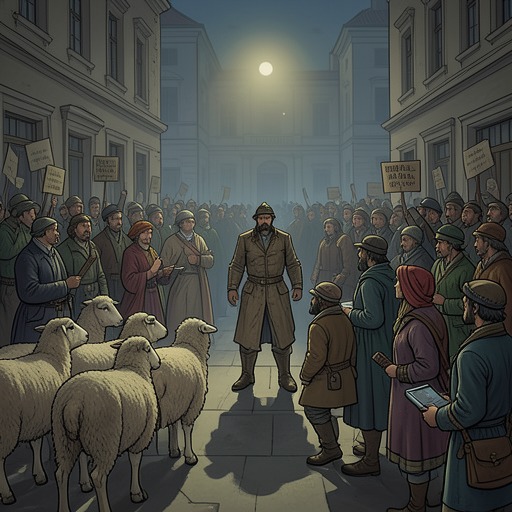
The room is arranged around the animals. A wooden platform stands in the middle of the hall, reached by ramps rather than steps; behind it, shepherds wait with their champion sheep. The arrangement makes the contest legible as a human spectacle organized for animal participants, while Holmes looks on as a professional who cannot imagine the sheep supplying evidence. That contrast sharpens when the case solves itself on the stage. The source of knowledge he has discounted becomes the means by which the truth is made visible, reversing his assumption that the decisive clue must come from conventional police investigation.
The revelation about George Glenn
Watching the sheep’s performance, Holmes understands that George Glenn died by suicide and that the gray-haired woman was responsible for the business with the spade. In retrospect, he finds the staging plausible, but he does not mistake a solved case for complete understanding. He thinks of George as a lonely, eccentric old man whose marriage had failed and whose daughter was gone, yet concludes that the reason for such an act remains beyond what he can truly comprehend. The distinction matters: Holmes can recognize the explanation presented by the contest without claiming access to George’s inner life.
The discovery also overturns Holmes’s earlier readiness to arrest the heirs. The family suspicion that had seemed like his only route to an arrest is displaced by a truth revealed through the sheep, not by the shortcut he had contemplated. His reaction is stunned rather than celebratory. The solution gives him an answer about the case, but no simple confidence in himself, and it leaves the human event behind the evidence opaque to him.
The cassette and an uncertain future
A quiet throat-clearing interrupts Holmes’s thoughts. A discreetly dressed man appears beside him, difficult to describe even minutes later, and identifies his border collie as Murph. Holmes recognizes the visitor as someone who has expected him to keep quiet; the man answers that the inspector has been silent and praises his inactivity. Their exchange places Holmes under observation even as he believes himself to be merely waiting out a failed investigation. The visitor’s understated manner contrasts with the public contest around them, and his arrival changes the scene from a police case closing to the possibility of another opening.
The stranger offers Holmes the prospect of a genuinely successful investigation of his own and leaves a videocassette beside the inspector’s Guinness. He says it concerns McCarthy and might do Holmes’s career some good. By the time Holmes has put the unwieldy cassette in his pocket, the man has disappeared, leaving no opportunity for questions. The offer therefore comes with both a lead and an absence: Holmes is given material that could advance another case, but not the explanation of who supplied it or why.
Holmes notices a beer mat promising fame and fortune through Guinness, an oddly apt image beside the cassette and the prospect of professional success. Yet the decisive change is inward. He feels uncertain about his life and the police station, and about whether he wants to return there at all. He leaves his glass half full. The unfinished drink makes no formal announcement of resignation or renewal; it marks a pause at the moment when the case has been solved, another investigation has been placed within reach, and Holmes can no longer take his return to police work for granted.